
Craig DiVizzio

Want more from life? ASK for it!

You create the life you have by the choices you make – what you choose to do and choose not to do. It’s true that life sends some stuff your way that you don’t choose, but you control what you get.

One choice I encourage you to make is to ask for what you want.

I remember being in a relationship with a woman who brought home pair after pair of new shoes, and bragged that they were all leather and she didn’t pay a dime for them. When I asked her how she got them, she replied, “I asked for them.”

She was fortunate to wear the same size as the samples, and she was intentional in asking for what she wanted – free, all leather shoes! It was amazing how many salespeople would give away those sample sizes. If I had not learned how valuable it was to ask for what you want before then, I learned it from her. By the way, her name was not Imelda Marcos!

Many people struggle to ask for what they want. They also have a hard time saying no to others and yes to themselves. A consequence of not asking for things is you don’t get all you deserve. I want you to get everything you deserve in life, so let’s examine how to ask.

First, you need to move past the barriers that keep you from asking. Listed below are some of them, and my responses.

Reason: I shouldn’t have to ask, they should already know what I want.
Counter: Sometimes people don’t know. Sometimes they do know but expect you to ask for what you want. If I were a car salesman and knew you wanted a discounted price, I wouldn’t give it to you unless you ask!

Reason: I fear conflict, and do my best to avoid it.
Counter: There is no way to avoid conflict – you are simply choosing the location of the conflict. You are choosing between a potential conflict with someone else when you ask OR a guaranteed conflict with yourself when you don’t muster the strength to ask. Beating yourself up lasts longer and does more damage to your self-esteem. It can also become a vicious cycle: You don’t ask, you don’t receive, you internalize that you don’t deserve, which discourages you from asking—repeat the cycle.

Reason: I’ve had negative experiences in the past when asking for things.
Counter: Don’t let past disappointments stand in the way of future successes. Learn how to control the factors that influence results – then start asking again. Learn about making requests and using the proper body language, facial expressions, tone of voice, eye contact, volume and inflections, and presentation of information.

Reason: I’m a people pleaser and tend to put others’ needs ahead of mine.
Counter: The more you take care of others, the more important it is that you maintain good health. You need to be self-oriented and say yes to taking care of yourself and no to others’ requests. When reenergized, you can go back to taking care of others.

Reason: Asking shows weakness.
Counter: Asking for what you want shows strength – strength that you can take care of yourself. Find a successful person, and you will find an assertive person who asks for what they want.

What is the best way to ask?

  • the easier it is for you to ask, the easier it is for them to say no or deny your request
  • the harder it is for you to ask, the harder it is for them to say no or deny your request

Method: written – text, email, letter
Difficulty: easiest to do – easiest to ignore or reject

Method: verbally from a distance – phone, skype, facetime, teleconference
Difficulty: harder to do, harder to ignore or reject

Method: verbally in person – face to face
Difficulty: hardest to do, hardest to ignore or reject

I always make it hardest on myself, because I want to make it hardest on them to say no.

Asking for what you want will change your life. You won’t always get what you want, but it’s your best chance to do so. The biggest reward is internal; even if they deny your request, you will feel good about yourself for asking!

One last tip, if you haven’t asked much in the past, you will not feel comfortable asking now. Don’t wait till you are comfortable; you will only get more comfortable with practice and some positive results.

Ask more of yourself and get out of your comfort zone. You may find the results appealing enough to make it a new habit. Who knows, you may end up with a closet full of shoes – or more of what YOU want from life!

That’s my perspective, what’s yours? , and don’t miss the video on this topic on YouTube!
Why You Should Talk To People You Disagree With

Why You Should Talk To People You Disagree With

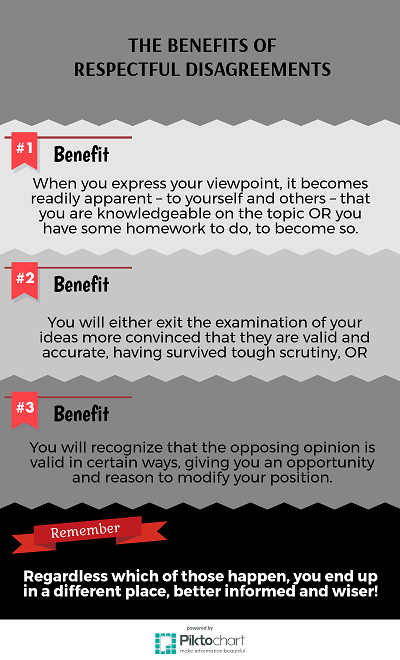
I have always believed that talking to people I disagree with has tremendous value, as does reading and watching content that promotes a viewpoint contrary to mine. I must admit, it’s not always easy, but I’m definitely wiser in the end.

I’m pretty sure that perspective is not shared by all – especially lately. The divide between people with opposing views appears to be getting larger, to the point where I’m questioning whether the statement ‘agree to disagree and respectfully coexist’ still applies.

I think the ‘it’s not easy’ part is helping to divide us when the ‘I’m wiser in the end’ part ought to be uniting us. What’s likely causing this divide?

  • News and talk shows promote more biased and skewed views of the facts, causing people to completely avoid some shows and gravitate to those they agree with.
  • Individuals spend more time in social media engineered echo chambers – having their viewpoints validated by like-minded individuals.
  • Businesses encourage employees not to discuss controversial subjects while at work.
  • Many companies foster unspoken mandates such as ‘we must all agree for the good of the team’ and ‘don’t say anything that might be upsetting to another.’

In spite of the heralded message to value ALL ideas, it appears we are losing our penchant for valuable, respectful exchange when views differ. I believe that when you recognize there is an opportunity to benefit from the exchange, the benefits reveal themselves.

Take the challenge to grow!

  • Move outside your social media feed. Read and watch things you know you will disagree with – at least partially – if not totally.
  • Listen to talk shows and watch newscasts that promote opinions different than yours.
  • Talk more often to people who disagree with you on certain topics.

Caution: This may cause emotional upset. Decide that no matter what happens, you will stay respectful in what you write, say or do. When interacting, I suggest you adopt the habit of replacing the words right and wrong with agree and disagree, as much as possible.

Telling someone that you’re right and they’re wrong is positioning yourself as the all-knowing judge and jury. In claiming the high ground, you’re suggesting there’s no point in disagreeing with you. Saying right and wrong can end discussions (and infuriate people) while using agree and disagree leaves room to continue the discussion beyond the point of disagreement.

Also, it helps to say I agree or disagree with your idea” rather than I agree or disagree with you.” You have ideas, but you and your ideas are not the same things – ideas can more easily be changed.

You can have great conversations and relationships with people you disagree with – even strongly disagree with. I disagree with many of my friends over multiple issues, and I love that we remain friends.

In fact, I value them – even more – because we have learned to disagree, learn from each other, and continue a relationship. More important, you can too!

That’s my perspective, what’s yours? Leave us a comment or question below , and thanks for listening!

The Powerful Payoff Of Patience And Persistence

Are you giving up on yourself and others too quickly – keeping yourself from accomplishing all you are capable of? If so, I’d like to help you change that self-defeating behavior.

We all know that if you’re responsible for getting a young adult or teenager to clean their room, study, stop a destructive behavior, or set the table, you need to ask or tell them repeatedly.

When it comes to adults, however, we expect that one time of asking or telling them (or ourselves) is sufficient. Man, that would be nice, but I don’t believe it works that way.

We don’t hit some demarcation line called adulthood – and in an instant – changing and disciplining our behavior becomes easy. Yet, I find people who believe it should be, and get frustrated when it isn’t.

  • Managers complain they repeatedly need to tell experienced employees to do their jobs – and shouldn’t have to say it more than once.
  • People say they’ve told a friend who’s engaged in a destructive behavior just how destructive it is – many times – and telling them once should have been enough.
  • Entrepreneurs attempt to start a business multiple times, still aren’t successful, and believe the effort they expended ought to have been enough.

Saying those words leads to one emotion – frustration. Frustration that you didn’t get the results you expected. The problem isn’t that you set an expectation of what you thought it should take, it’s that you chose to get frustrated and give up. I know it’s tempting to respond that way, but it’s keeping you from reaching your potential.

Whether you were realistic and justified, or idealistic to expect what you did, the reality is that you or they did not meet your expectation. How do you respond when that happens? I suggest you accept the reality of what is, move past the paralysis of frustration as quickly as you can, and ask yourself two questions. Am I required to put more time and energy into this situation, and is the potential result worth the additional time and effort?

  • An answer of no to both suggests you let it go, and the frustration should leave.
  • If the frustration persists, you may have underestimated the importance of this – so reconsider your answers to the two questions.
  • An answer of yes to either suggests you (re)design how to get different results.

Will you use a different approach or strategy? Get more information or ask for someone’s help?

Whatever you choose to do, I believe the more important it is to you, the more whatever it takes is the only appropriate time and effort limit!

  • You say, “I tried five times.” I say, “Maybe for you, it’s going to take eight times.”
  • You say, “I already spent 16 hours on this.” I say, “Maybe you need 25 hours.”

At times, the only person keeping you from success is you, by the limits you set!

Albert Einstein said, “It’s not that I’m so smart, it’s just that I stay with problems longer.

Do you have the skills and desire to go further, to do more and accomplish more than you have to this point? Be patient and persistent with yourself and others – and remove the limits.

You are capable of more than you think.

That’s my perspective, what’s yours? Leave us a comment or question below and don’t miss the video on this topic on YouTube!

Get Weekly Newsletter Updates From Craig